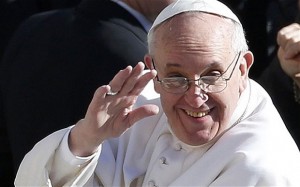
This version of The Weekly Francis covers material released in the last week from 22 July 2018 to 22 August 2018.
The Weekly Francis is a compilation of the Holy Father’s writings, speeches, etc which I also post at Jimmy Akin’s blog.
Angelus
General Audiences
Letters
Messages
- 15 August 2018 – Message of the Holy Father for the 450th anniversary of the death of Saint Stanislaus Kostka
- 19 August 2018 – Message sent by the Secretary of State on behalf of the Holy Father on the occasion of the 39th Meeting for Friendship among Peoples [Rimini, 19–25 August 2018]
- 21 August 2018 – Video message of the Holy Father on the occasion of his upcoming Apostolic Journey to Ireland [World Meeting of Families in Dublin, 25 – 26 August 2018]
Speeches
Papal Tweets
- “When we place ourselves at the service of our most vulnerable brothers and sisters we experience the joy of unconditional love.” @Pontifex 10 August 2018
- “In silence we learn to contemplate God’s works, which surpass all our imagination.” @Pontifex 11 August 2018
- “Thanks to the gift of the Eucharist, our lives too become “bread broken” for our brothers and sisters.” @Pontifex 12 August 2018
- “Still today there are so many martyrs, so many who are persecuted for the love of Christ. They are the real strength of the Church!” @Pontifex 14 August 2018
- “Mary, Mother of tenderness who is always near, teach us how to live and have faith.” @Pontifex 15 August 2018
- “Faith is nourished by memory: how many wonderful things God has done for us! How generous is our heavenly Father!” @Pontifex 16 August 2018
- “By embracing God’s love, we change the world and transform history.” @Pontifex 17 August 2018
- “Love overcomes all difficulties. Love gives us the strength to carry on.” @Pontifex 18 August 2018
- “The Eucharist, Jesus the Bread of Life, is the beating heart of the Church and renews in us the impulse to love.” @Pontifex 19 August 2018
- “May the Holy Spirit grant us the grace of conversion and the interior anointing needed to express before crimes of abuse our compunction and our resolve courageously to combat them. http://w2.vatican.va/content/francesco/en/letters/2018/documents/papa-francesco_20180820_lettera-popolo-didio.html …” @Pontifex 20 August 2018
- “Today the World Meeting of #Families begins in Dublin. Let us join in prayer with all the families of the world, especially those in difficulty. @WMOF2018 @LaityFamilyLife” @Pontifex 21 August 2018
- “The #Family is where hope is forged.” @Pontifex 21 August 2018
- “We must protect the #Family. Our future depends on it.” @Pontifex 22 August 2018
Papal Instagram